Effective drought lawn care Gallatin TN fescue summer strategies involve watering your grass deeply with one to two inches of water per week and maintaining a mowing height of at least 3.5 inches. These methods help your lawn survive the heat by promoting deep root growth; alternatively, you can allow the fescue to go dormant to protect it from extreme Tennessee temperatures.
Watching your lush green fescue turn brittle and brown under the relentless Tennessee sun is a source of anxiety for many Gallatin homeowners. While this cool-season grass excels during our mild springs, the combination of high humidity and soaring July temperatures often triggers a survival mechanism that looks a lot like a dying lawn. Maintaining a healthy landscape during a drought requires more than just luck; it demands a strategic approach tailored to our local environment. In this guide, we will help you diagnose whether your grass is truly dead or simply dormant. You will also learn the best drought lawn care practices for Gallatin, TN, including how to manage fescue in heavy clay soil and which mowing adjustments will protect your turf through the peak of summer.
The Challenge of Growing Tall Fescue in Gallatin, Tennessee
Gallatin sits squarely within the transition zone, a challenging climate where neither cool-season nor warm-season grasses are perfectly adapted. Tall Fescue is a cool-season variety that thrives in the spring and fall but enters a state of high stress during the peak heat of July and August. In a perfect environment, fescue is known for its deep root potential, often reaching over two feet into the earth to find moisture. However, the heavy clay soil common across Sumner County complicates this biological advantage.
When a dry spell hits, our local clay bakes into a dense, nearly impenetrable layer. This hard-pan condition prevents water from soaking deep into the ground, causing runoff instead of hydration. Without the ability to penetrate this "brick" of soil, fescue roots remain shallow and vulnerable to the scorching Tennessee sun. At Clayton’s Lawn & Landscape, we understand these local soil dynamics intimately. We provide dependable lawn care services that account for the fact that effective drought lawn care Gallatin TN fescue summer strategies require more than just a sprinkler; they require an approach that respects the physical limitations of our clay.
Properly managing this stress often starts with aeration and overseeding in Gallatin to improve soil structure, but once the heat arrives, the focus shifts to survival. This soil compaction often leaves lawns looking brittle and brown by mid-August, leading many homeowners to wonder if their grass has finally given up the ghost or is simply waiting for cooler weather.
Dead vs Dormant Grass: How to Diagnose Your Fescue

Seeing your lawn turn from a lush emerald to a parched tan can be stressful for any homeowner in Sumner County. During a typical July heatwave, many residents assume their grass has died and needs a complete renovation. However, fescue is a resilient plant that utilizes dormancy as a biological self-defense mechanism. When temperatures soar and soil moisture evaporates, the plant intentionally shuts down its foliage to protect the crown, which is the vital growing point located at the soil surface. Think of it as a form of hibernation designed to preserve the plant's life until cooler, wetter conditions return.
To determine if your lawn is resting or truly gone, you can perform a few simple diagnostic checks. The most reliable method is the tug test. Grab a handful of brown blades and give them a firm pull. If the grass stays firmly anchored in the clay soil, it is likely dormant and waiting for moisture. If the clump pulls out of the ground easily with little to no resistance, the root system has likely failed.
Characteristic | Dormant Fescue | Dead Fescue |
|---|---|---|
Color | Straw-like or golden tan | Dull gray or dark brown |
Texture | Flexible, though dry | Brittle and crumbles easily |
Base of Plant | Slight green tint at the crown | Entirely brown or black |
Root Strength | Resists pulling (tug test) | Pulls up with no effort |
Visual cues are equally important for effective drought lawn care Gallatin TN fescue summer planning. Dormant fescue often retains a slight green or whitish tint right at the base of the plant, which you can see if you part the brown blades and look closely at the soil line. Dead grass, by contrast, appears uniform in its decay and often looks matted or shriveled. Understanding this distinction is vital before you change your strategy for watering your Gallatin lawn; a dormant lawn requires specific, minimal hydration to keep the crowns alive without forcing an exhausting growth cycle.
The Dormancy Debate: Should You Keep Watering or Let It Go Sleep?
Once you have confirmed that your fescue is dormant rather than dead, you face a strategic choice. You must decide whether to fight the Tennessee heat to keep the grass green or allow the lawn to enter its natural resting state. Both options are viable, but they require vastly different levels of commitment and resources.
Strategy | Water Requirement | Maintenance Level | Primary Goal |
|---|---|---|---|
Active Growth | 1.5 to 2.0 inches per week | High | Maintaining green aesthetics |
Managed Dormancy | 0.5 inch every 2 to 3 weeks | Low | Crown survival until fall |
Maintaining a lush, green lawn in Gallatin during a drought is a significant undertaking. To counteract the intense Sumner County sun and the low water-retention of our local clay, fescue requires roughly 1.5 to 2 inches of water per week, ideally split into two or three deep sessions. This volume ensures the plant continues active photosynthesis. If you choose this path, consistency is mandatory; missing even a few days during a heatwave can cause the grass to crash, wasting the water you previously applied.
Choosing dormancy is an environmentally friendly way to handle drought lawn care Gallatin TN fescue summer stress, but it is not a total "hands-off" approach. A common mistake is stopping all irrigation entirely. If the soil remains bone-dry for more than four weeks, the crowns will eventually dehydrate and die. To prevent this, we recommend the survival drink method. Applying a half-inch of water every two to three weeks keeps the vital tissues hydrated without triggering the grass to turn green and expend its stored energy.
Be cautious of the yo-yo effect. The quickest way to kill a fescue lawn is to apply just enough water to break dormancy, causing the grass to turn green, and then stopping that water during the next dry spell. This forces the plant to use its final energy reserves to wake up, only to be scorched without further support. Deciding which path to take depends on your budget and your ability to stay disciplined with watering your Gallatin lawn throughout the dog days of summer.
Drought Lawn Care Strategies for Gallatin Clay Soil

Effective drought lawn care Gallatin TN fescue summer planning requires a realistic understanding of our local geology. Sumner County is defined by its heavy, orange clay, which presents a unique challenge during a dry spell. While clay holds nutrients well, it has a very slow infiltration rate. If you set your irrigation to run for thirty minutes straight, you will likely see water pooling or running into the street after the first ten minutes. This happens because the surface of the clay saturates quickly, creating a barrier that prevents deeper penetration to the root zone.
To combat this, we recommend the cycle and soak method. Rather than one long session, program your irrigation zones to run for several short intervals, such as ten minutes each, with an hour of rest in between. This pause allows the water to percolate through the dense clay particles before the next application arrives, ensuring the moisture actually reaches the roots.
Watering Method | Application Frequency | Benefit for Gallatin Clay Soil |
|---|---|---|
Cycle and Soak | 2-3 short intervals per morning | Prevents surface runoff and maximizes absorption |
Deep and Infrequent | 2-3 days per week | Encourages roots to grow deeper into the soil |
Light Daily Misting | Every morning | Discouraged: Leads to shallow, heat-sensitive roots |
Timing is just as critical as technique. Always finish watering your Gallatin lawn before 8:00 AM. This takes advantage of lower wind speeds and cooler temperatures, ensuring the water reaches the soil instead of evaporating. You can verify your success using the screwdriver test. Push a long screwdriver into the turf. In a properly hydrated lawn, it should slide six inches into the ground with minimal resistance. If the tool stops short or cannot penetrate the soil, your watering sessions are too shallow to sustain your fescue through the peak of August.
Adjusting Your Mowing Routine for Summer Heat

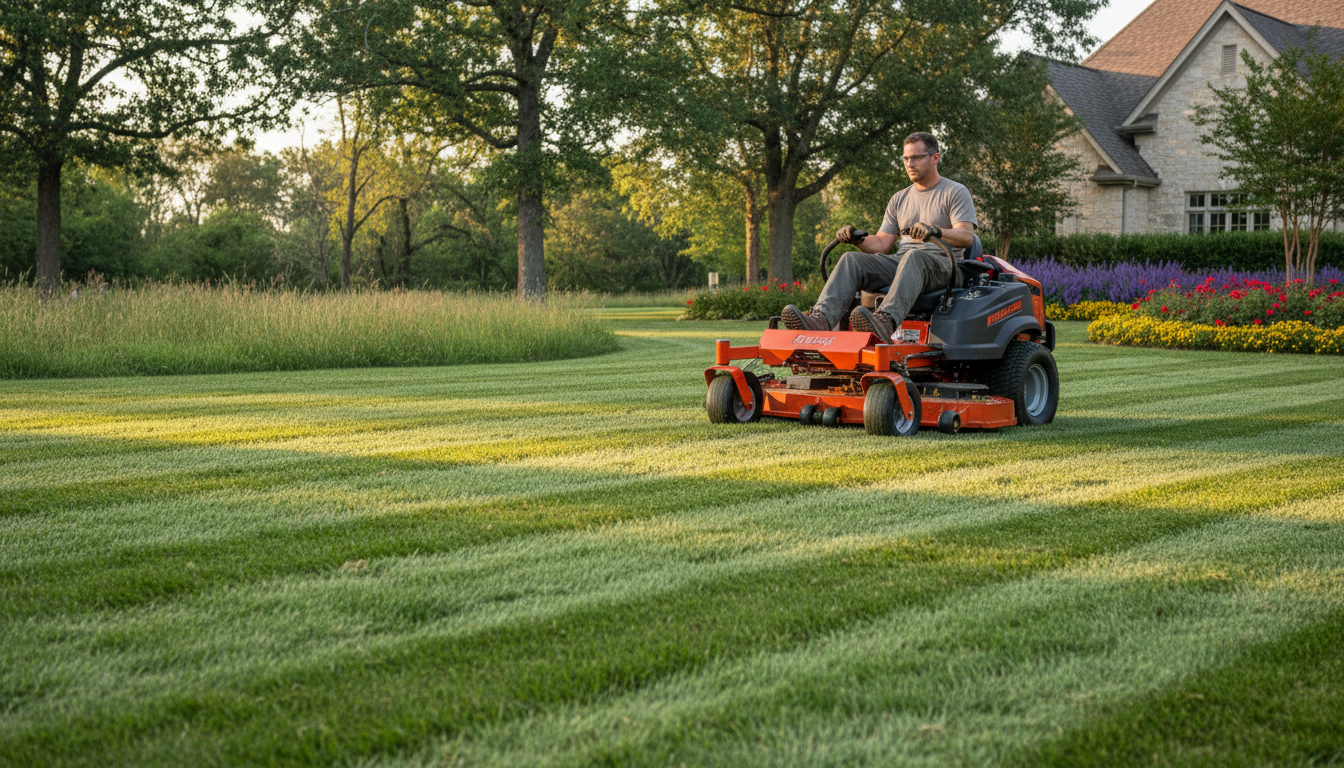
Proper hydration is only half the battle during a dry spell. How you mow can either support your watering efforts or undo them entirely. For effective drought lawn care Gallatin TN fescue summer management, we adhere to a strict 4-inch rule. Keeping the fescue tall is vital because longer blades act as a living umbrella. They shade the soil surface, which significantly slows down evaporation and keeps the root zone several degrees cooler than a scalp-level cut.
Avoid mowing during the peak heat of the day, usually between 11:00 AM and 5:00 PM. If the lawn is under extreme drought stress, it is often better to skip a week entirely. Pushing a heavy mower over brittle, dormant crowns can cause physical damage the plant cannot repair until the weather cools.
At Clayton’s Lawn & Landscape, we provide dependable lawn care services by manually adjusting our mower decks as the temperature climbs. We ensure our equipment is set to the highest possible setting to protect the lawn's health. We also maintain razor-sharp blades throughout the season. A dull blade tears the grass rather than slicing it cleanly, leaving a jagged, white edge that loses moisture rapidly. A clean cut allows the plant to seal the wound quickly, preserving vital water for the crown.
What to Avoid: Three Common Mistakes That Kill Fescue in August
Managing a lawn through a Tennessee heatwave often requires knowing what to stop doing as much as what to start doing. Successful drought lawn care Gallatin TN fescue summer planning depends on avoiding three high-impact mistakes that can turn a temporary dormancy into a permanent loss.
Applying Nitrogen Fertilizer: High-nitrogen fertilizers are essential in the spring, but applying them in August is a recipe for disaster. Nitrogen forces the plant to produce new green growth. During a drought, fescue lacks the moisture and energy to support this foliage. This forced activity depletes the plant’s internal sugar reserves and can lead to fertilizer burn in the root zone. Wait until the cooler temperatures of aeration and overseeding in Gallatin season to resume feeding.
High Traffic on Dormant Turf: When fescue goes dormant, the blades and crowns become brittle. Foot traffic, or the heavy weight of a parked vehicle, crushes these fragile tissues against our compacted clay soil. While healthy, hydrated grass can bounce back from pressure, dormant grass often sustains crown damage that prevents it from waking up in September. Keep pets and children off the brownest areas to protect the growing points at the soil line.
Ignoring Brown Patch Fungus: Homeowners often see brown spots and assume the lawn simply needs more water. However, Brown Patch fungus thrives in Sumner County’s humid summer nights.
Condition | Appearance | Pattern |
|---|---|---|
Drought Stress | Uniform tan or straw color | Wide areas or south-facing slopes |
Brown Patch | Tan centers with dark smoke rings | Circular patches 6 inches to several feet wide |
Misidentifying fungus as drought can be fatal. If you increase your watering your Gallatin lawn routine while Brown Patch is active, you provide the moisture the fungus needs to destroy the entire yard. Inspect the grass blades closely; fungus often leaves visible lesions or spots on the blade, whereas drought causes the blade to curl and turn a uniform color. At Clayton’s Lawn & Landscape, we provide dependable lawn care services that help identify these issues before they ruin your investment.